
Description
“Caciocavallo”
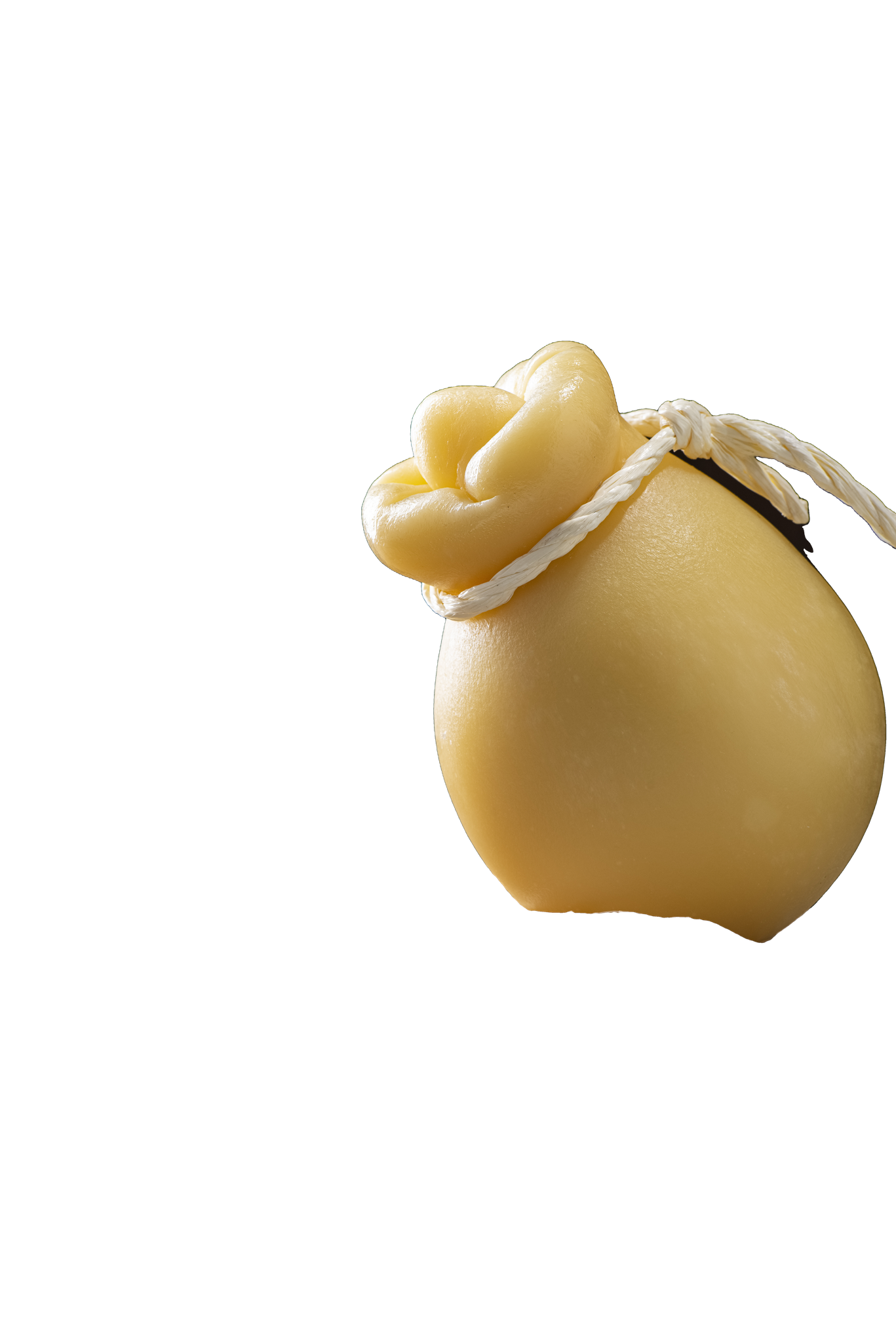
The Caciocavallo is one of the oldest and most fascinating cheeses of southern Italy. Like the Provolone del Monaco, it belongs to the family of pasta filata cheeses (stretched-curd cheese), but has its own legendary story and shape. A raw, semi-cooked whole-milk cheese made from stretched cow’s milk. It is distinguished by its pear shape with a short neck and head, an average diameter of 10–18 cm, an average length of 20–30 cm and a weight of 1.2–2.5 kg. The thin rind hardens over time and changes colour from white to ivory, light yellow and hazelnut brown. The interior of young Caciocavallo (aged 2–3 weeks) is firm, buttery, with a milky aroma and a slightly sweet, mild flavour. As it matures, the cheese becomes drier and harder, with an increasingly full, fascinating flavour, growing savoury notes and a strong, lasting aroma. The first ageing phase, which lasts at least 60 days, takes place in a cool environment with a relative humidity of 80%. The cheese is then stored cool and well ventilated until sale. Caciocavallo is oval or cone-shaped with a small head. It owes its name to the traditional ageing method, in which it is tied in pairs and fixed “astride” a support.
1. The secret of the name: “cheese on horseback”
The name Caciocavallo literally means “cheese on horseback” (cacio = cheese, cavallo = horse).
-
- The tradition: That comes from the traditional way of ageing. The small cheeses are tied in pairs on a cord and hung like saddlebags over a wooden pole (the “horse’s back”) to dry in the open air for months.
- The shape: Through hanging and its own weight, the typical teardrop or pear shape with a small head forms at the top, where the cord is tied.
2. Flavour and consistency
-
- Young (Caciocavallo Giovane): Aged for only a few weeks. It is straw yellow outside, soft and elastic inside, and tastes mild, sweetish and strongly of fresh milk.
- Matured (Caciocavallo Stagionato): Can age for over a year. The rind becomes dark and firm. The paste becomes crumbly and flaky, tasting intensely savoury, nutty and pleasantly sharp.
How firm it is depends almost exclusively on its ageing time:
- Young Caciocavallo (aged approx. 1–3 months): At this stage it is a semi-hard cheese. It is still relatively elastic, soft to the bite and wonderful sliced or melted.
- Old Caciocavallo (aged from 6 to over 12 months): The longer it hangs on its cord, the more moisture it loses. It dries out and becomes a hard cheese. In this state it turns crumbly (similar to Parmesan or Pecorino) and is excellent for grating.
The special feature: Since it belongs to the family of pasta filata cheeses, despite its firmness when matured it has a fibrous, flaky structure that becomes wonderfully creamy when chewed or melted.
Use: A table cheese, served as an ingredient on cheese boards or grilled as a main course. It is also ideal for pasta dishes to be enriched with cheese.
Recommended pairings: Not too old and not too tannic red wines (e.g. Negroamaro and Primitivo). Homemade regional bread.
Storage: Store refrigerated at 12° C.
Our Caciocavallo is a Caciocavallo Giovane (aged approx. 1 – 3 months).
Chemical composition & macronutrients for ageing of 1 – 3 months
| Parameter / nutrient | Average value per 100 g | |
|---|---|---|
| Water content (moisture) | 38% – 42% | Higher than in aged cheese; responsible for the elastic structure. |
| Dry matter (D.M.) | 58% – 62% | The totality of all solid components after water removal. |
| Protein | 26 g – 30 g | Mainly casein, made easily digestible by the onset of proteolysis (protein breakdown). |
| Fat content (absolute) | 28 g – 31 g | Of which approx. 18–20 g saturated fatty acids. |
| Fat in dry matter (FDM) | min. 44% – 48% | Legal/typical minimum value for Caciocavallo. |
| Carbohydrates / lactose | < 1.5 g | Almost completely broken down by lactic acid fermentation during ageing. |
| Salt (NaCl) | 1.2 g – 2.0 g | Depends on the duration of brine salting. |
| Energy value (calories) | approx. 370 – 400 kcal (1550 – 1670 kJ) | Slightly lower in calories than fully matured cheese due to the higher water content. |
Physico-chemical parameters
- Nitrogen fractions (degree of proteolysis): With ageing of 1 to 3 months, the proportion of water-soluble nitrogen (an indicator of protein breakdown) is still relatively low (approx. 8–12% of total nitrogen). The amino acids leucine, phenylalanine and lysine begin to be released measurably at this stage. [1]
Micronutrients & minerals (typical values)
- Calcium: approx. 800 – 860 mg (A very rich source thanks to the concentration of the milk).
- Phosphorus: approx. 550 – 600 mg.
- Cholesterol: approx. 90 – 100 mg.
Reviews
There are no reviews yet.