
Description
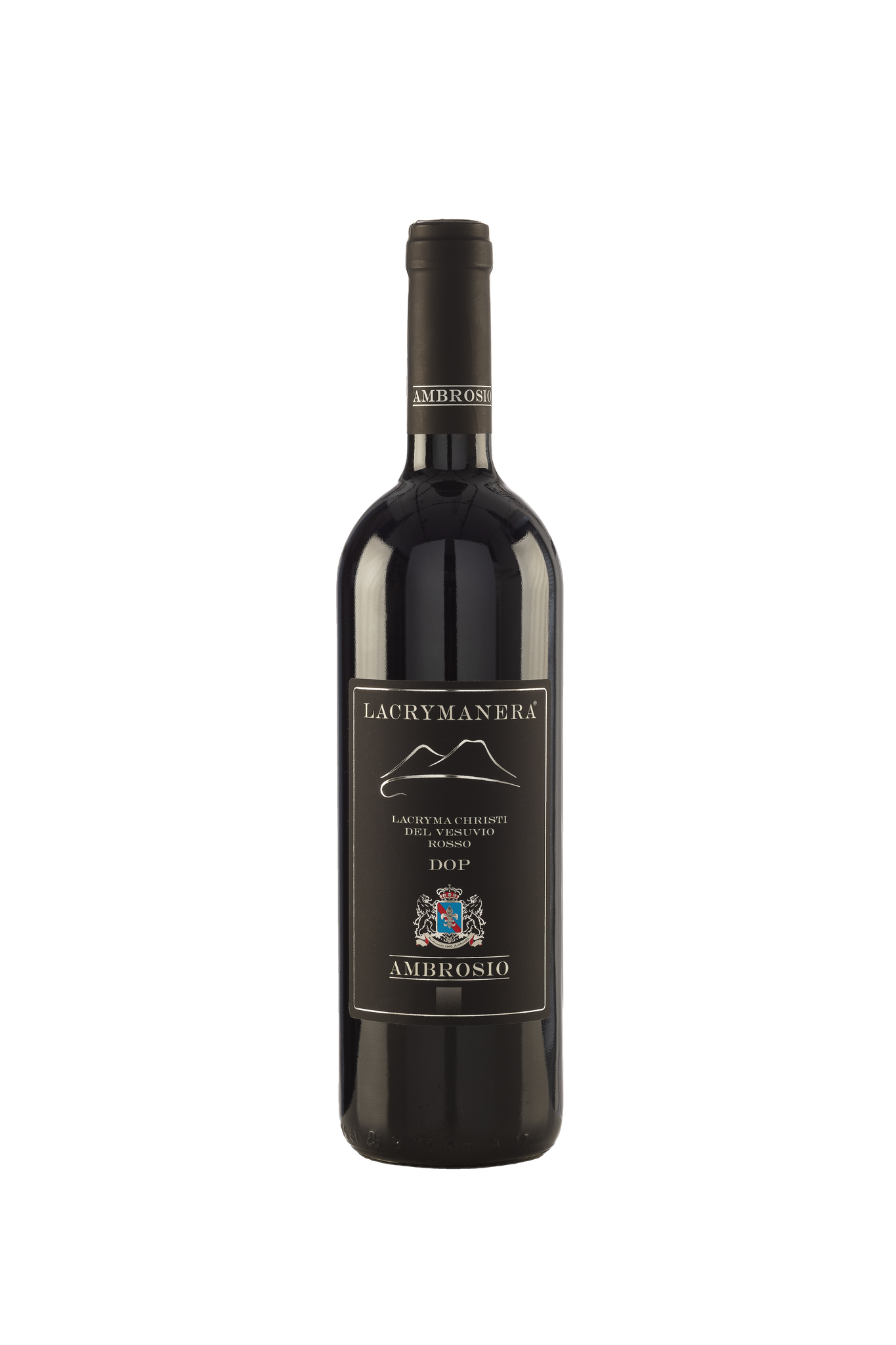
Lacrymanera – Lacryma Christi del Vesuvio Rosso D.O.P. (Protected Designation of Origin)
Ambrosio Winery
The Ambrosio winery, located in the Vesuvius area of the province of Naples, was born from the longstanding passion of the Ambrosio family, which has been cultivating vines in this region for more than ten generations. The family’s vineyards stretch along the slopes of Mount Vesuvius and enjoy a spectacular view of the sea. This land looks back on 4,000 years of winemaking tradition. Here, the energy of the volcano transfers into the fertile soil, and its power—shaped by the devotion of the Ambrosio family—comes to expression in the wines: a true pleasure and a delicacy for connoisseurs. As it has for thousands of years, the fruit is still gently caressed by the Fruscio, a typical sea breeze from the Gulf of Naples, and pampered by the sun from sunrise to sunset. This encounter of sea, land, and sky is the very essence of our wine, strengthened by its history and known all over the world as Lacryma Christi del Vesuvio.
The History
Lacryma Christi del Vesuvio DOP is the oldest wine of the Italian peninsula. Its history dates back to 1900, lost in the mists of time and surrounded by numerous legends. The best known says: on his descent into hell, Lucifer took a piece of paradise with him. In the Gulf of Naples, Jesus recognized what had been stolen from him and wept bitterly. From his tears, the Lacryma Christi vine miraculously grew. Another legend is just as well known: Jesus visits a hermit who had settled on the slopes of Vesuvius. Moved by the hermit’s admirable faith, before departing he transforms his hard-to-drink beverage into an excellent Vesuvius wine.
Vesuvius wines were already famous and sought after in Roman times, when a large part of the production was reserved exclusively for the imperial court. The works of many Latin poets are a triumph of hymns of praise to Vesuvius wine, which captures the magical essence of the hidden roots of the subsoil. The poet Martial extols, in one of his epigrams, the character and goodness of these hills: “Haec iuga quam Nysae plus Bacchus amavit” (Bacchus loved these hills more than his homeland Nysa). Recent archaeological excavations in the Vesuvius valley near the river Sarno, reaching back 4,000 years, brought to light significant evidence of ancient winemaking. At that time, wine served as a means of exchange for other products of daily need. According to Aristotle, the winemaking tradition on Vesuvius goes back to the Thessalians, who emigrated from their Greek homeland into the Vesuvius valley and planted the first vines there.
Around 1000 AD, Lacryma Christi was produced by only a few monks whose monastery stood on the slopes of Vesuvius. In the Middle Ages, the Jesuits took possession of all the land on the volcano, thus becoming the sole wine producers. Guardians of the sacred wine. Lacryma Christi. At the end of the 18th century and throughout the following two centuries, the producers of Vesuvius Lacryma Christi were honoured with numerous prizes and awards at the World Exhibitions in Paris. After gazing at the cliffs of Vesuvius, the German poet Friedrich Rückert sang a sweet nocturnal melody, illuminated by the special taste of our wine: “Oh boy, see, the night grows darker; drive the herd into the stable; and late at night our Lacryma Christi sparkles in the glass.” This legend was revived by Curzio Malaparte, who in his novel “La Pelle” invites us to drink this sacred, ancient wine.
Our Philosophy in the World of Wine
The company produces natural wines from a viticulture based on research and science, fully respecting nature. The work follows the physiology of the vine in the vineyard and its natural environment, intervening as little as possible and only when absolutely necessary. Our collaboration with the Faculty of Agriculture of the University of Naples Federico II has taught us the true meaning of research and respect for nature, and has turned our work away from decades of intensive and aggressive cultivation methods. Our product best represents the uniqueness of the Vesuvius area through:
- Old vines trained in the bush system: this cultivation method, typical of the Vesuvius region, ensures better balance of the plants. The Lacrymanera Riserva comes exclusively from old vines trained and supported on chestnut stakes which, unlike younger vines, are not exposed to strong stress during the summer months. Thanks to the age of some vines and the cultivation system applied, the grapes are influenced by the climate but not damaged by it, making every vintage unique.
- Handwork: thanks to our team, the vineyards are cultivated entirely by hand — all vegetative phases of the vine, from ploughing between the rows to pruning, from removing the shoots to the harvest.
- No synthetic fertilizers or systemic treatments: we apply exclusively traditional methods, including treatments with Bordeaux mixture, without using systemic or hormonal products that affect the lymphatic system of the vines. We fertilize exclusively with organic fertilizer and use nitrogen-containing fertilizers only as part of green manuring.
- Harvest exclusively by hand: carried out by experts who treat each grape with skill before placing it in the appropriate crates. This operation almost always takes place at the end of October, the optimal time for us, when the grapes have reached the right degree of ripeness, before being taken immediately to the cellar to continue the winemaking process and get the best out of the processed must.
- Minimal use of sulphur dioxide: this antioxidant and antiseptic substance, which occurs naturally in grapes, evaporates during winemaking and clarification. At this point, based on specific and detailed analyses, we adjust the quantity needed to protect the wine from oxidation — the absolute minimum required to preserve its organoleptic and aromatic properties and to guarantee optimal shelf life.
- No added selected yeasts: here too, we use exclusively the natural yeasts already present on the grape skins in order to obtain an outstanding product. Laboratory-bred yeasts, which large wineries use in winemaking, tend to accelerate fermentation and thereby halve the organoleptic properties and their complexity — a problem that is completely excluded when using only natural yeasts.
- Ageing: we use small and medium-sized steel tanks and forgo ageing in wooden barrels, as these give the wine an almost immediate woody taste and cover the organoleptic properties of our product, which arise exclusively from the typical biodiversity of the Vesuvius area surrounding the vineyards. After 12–14 months, in which the wine stabilizes and clarifies naturally, we bottle it by hand and then begin the ageing.
Lacrymanera – Lacryma Christi del Vesuvio Rosso D.O.P.
Lacrymanera is a traditional and elegant wine of intense ruby red colour, as lively and radiant as if it had sprung directly from Vesuvius. It exudes a pleasant aroma of red fruits, is dry and harmonious in taste, complex and full-bodied, and possesses exactly the right amount of tannins. Made from an ancient cuvée of the Piedirosso, Aglianico and Sciascinoso grape varieties, it presents a very complex nose with distinct spicy notes, accompanied by aromas of red fruits with nuances of violet. On the palate it is silky and well structured, with excellent persistence, fresh notes and a natural, aromatic bouquet. This noble wine pairs ideally with pasta starters with meat sauces or fish soups, fried red meat, fine poultry, game, spicy and strong cheeses, and also harmonizes excellently with the finest dishes of Mediterranean cuisine. The vineyards lie on the slopes of Vesuvius and are characterized by an abundance of natural, mineral-rich volcanic slopes and excellent sun exposure.
Technical Data Sheet
- Origin: Vesuvius, Campania, Italy
- Grape varieties: Piedirosso 60% – Aglianico 20% – Sciascinoso 10%
- Soil: Sandy-volcanic
- Training system: Double Guyot at approx. 550 m above sea level
- Yield per hectare: 6,000 kg
- Harvest: By hand, early October
- Vinification: Steel tank, bottle ageing
- Serving temperature: 16–18 °C (we recommend decanting the wine one hour before)
- Alcohol content: approx. 14.0% vol. (depending on vintage)
- Vintage: 2018
Flavour Profile
- Appearance: Deep, almost impenetrable ruby red with garnet-red nuances at the rim.
- Nose: A beguiling and complex bouquet of ripe blackberries, dark cherries and dried plums. Fascinating nuances of graphite, volcanic ash, cocoa, fine vanilla and a hint of Mediterranean maquis spice join in.
- Palate: On the palate it presents itself silky, opulent and with remarkable density. The ripe, perfectly integrated tannins elegantly coat the mouth. Its volcanic minerality provides fantastic freshness despite the power, leading into a long, aristocratic finish.
The Secret of “Lacrymanera”
The grapes — predominantly the noble Aglianico vine, complemented by traditional local varieties such as Piedirosso — grow in the best steep slopes directly on the flanks of Vesuvius. The extremely high proportion of black volcanic sand and ash stores the heat of the day and gives the vines a unique smoky spice. Through rigorous yield reduction and gentle ageing, a wine of monumental structure and excellent ageing potential is created.
Food Pairing
A majestic wine that demands adequate companions. Excellent with a hearty Bistecca alla Fiorentina, braised wild boar, herb-crusted rack of lamb or intensely aromatic, long-matured hard cheeses.
Reviews
There are no reviews yet.